


Volumetric manufacturing

The future of
manufacturing
is volumetric.

We believe in a world where products are made quickly, efficiently and locally. Where things are made for the individual, not the masses. Where overproduction is eliminated, because everything is made on demand.

Support from
Intrepid OregonThe EngineDefense Innovation UnitMIT Startup ExchangeHello TomorrowOnami
Approach

Conventional 3D printing builds parts one slice at a time.
We print the whole part all at once.

Conventional · Layer by layer00/24 layers
Z
Sequential curelayer by layer
MAV · VolumetricEXPOSING
Single exposurewhole-part cure

Every commercial printer in production today is layer-bound. Throughput is set by the time it takes to traverse Z, layer after layer. Hours per part.

MAV projects calibrated light into a volume of resin. Where the integrated dose crosses the cure threshold, material solidifies — everywhere, simultaneously. The whole part appears in a single exposure.

Time per part, typical
3min
Industry standard for engineering-grade parts: roughly five hours.
Speed
01

Minutes, not hours

Most 3D printing systems take hours to produce a part, layer-by-layer. MAV projects light images into a rotating vial of resin to form parts almost instantly, with no layer lines.

Time per part · same shape, both processes
01h2h3h4h5hMAVVolumetric0 minIndustry standardLayer printer0 min
Materials
02

Engineering-grade parts, not demos

Conventional 3D printing is constrained to thin, low-viscosity resins. MAV prints with materials up to 20× more viscous — the chemistries that produce structurally sound, end-use parts.

Volumetric cure also removes the layer-adhesion failure mode, which is what disqualifies most 3D-printed parts from real load paths today.

Resin viscosity advantage
20×
Versus the low-viscosity resins that bound conventional 3D printing.
Material envelope · viscosity range available to each process
Commercial 3D printingInjection moldingCompression moldingMAV10⁻³10⁻²10⁻¹10⁰10¹10²10³WATEROILHONEYBUTTERViscosity (Pa·s, log scale)
Layerless
03

Layerless by construction

Structural

Between layers are where conventional 3D-printed parts fail under load. MAV creates layerless, monolithic parts that are stronger and more resilient.

Optical

Layer lines from traditional 3D printing aren’t removable, even with polishing or vapor smoothing. MAV prints optically clear parts, with no layer lines.

Plano-convex lens cross-section · structural and optical consequence
ConventionalScattering centerLayer interfaces · scattering centersOptical · scatteredMAVMonolithic0 interfaces · continuousOptical · clear
Overprinting
04

Print directly over electronics and metals

Process

Volumetric exposure cures the resin around an inclusion in the same single illumination it cures the bulk part. No nozzle has to traverse the surface; no print head has to make contact. MAV is the only additive technology that can print directly over electronics or metals.

Geometry

The inclusion sits in the resin volume; cured polymer forms around it. Sensors, antennas, magnets, board assemblies — components that would have been added in a second step on a layer printer can be encapsulated in the print itself.
Inclusion in cured volume · single-illumination encapsulation
ConventionalPrint headToolpath collisionCannot print over · second step requiredLayer process · z-axis blocked by inclusionMAVEncapsulatedCures around inclusion · single illuminationVolumetric · no toolpath, no contact
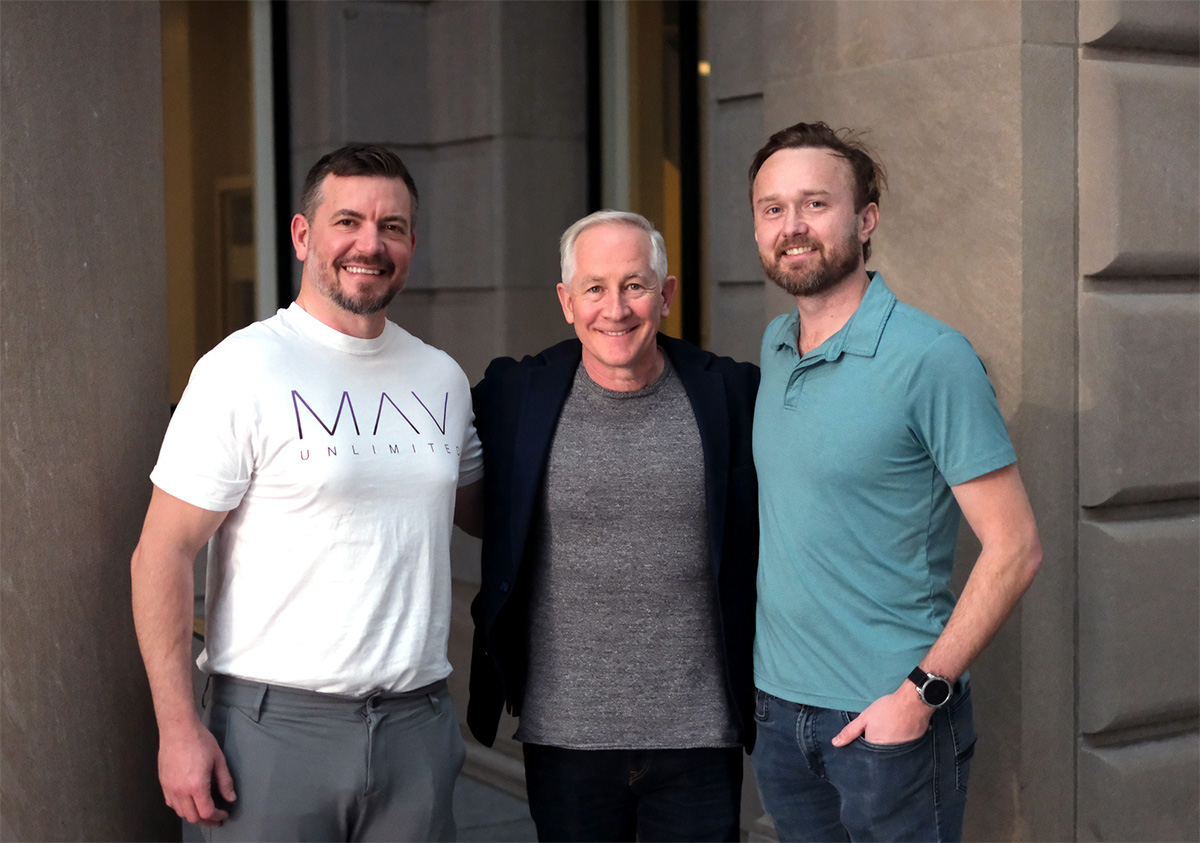
MAV Unlimited founding team
The team

World-class engineering and business expertise

Co-founded by Prof. Robert Shepherd (Cornell, scaled volumetric printing 30×), Aaron Pempel (CEO, former Nike GM), and Prof. T.J. Wallin (MIT, 35+ patents).

Meet the team
Updates

Recent updates.

Hello Tomorrow Deep Tech Pioneer logo
February 17, 2026Paris, France

Hello Tomorrow Deep Tech Pioneer

Of 4,800 global applicants, MAV was designated a Deep Tech Pioneer by Hello Tomorrow.

Read the full update
The Engine logo
January 30, 2026Cambridge, MA

The Engine

MAV is excited to announce we’ve been accepted into The Engine, an MIT spinout that supports “Tough Tech” startups with mentorship, connections, and lab space.

Build with us

Come Build With Us.

Visionary Investors. Intrepid Engineers. Industry Trailblazers.